AI in healthcare
AI-powered coaching suggestions


Project Duration
4 weeks
Team
Designer, CTO, Frontend devs
Outcomes:
Coach efficiency & Quality output
AI in healthcare
AI-powered coaching suggestions
Improving coach efficiency and care quality by introducing AI suggested chat responses
AI in healthcare
AI-powered coaching suggestions
Project Duration
4 weeks
Team
Designer, CTO, Frontend devs
Outcomes:
Coach efficiency & Quality output
Project duration
4 weeks
Team
Designer, CTO, Frontend devs
Outcomes:
Coach efficiency & Quality output
Overview
One of Oviva's biggest product goals was improving coach efficiency without compromising the quality of care.
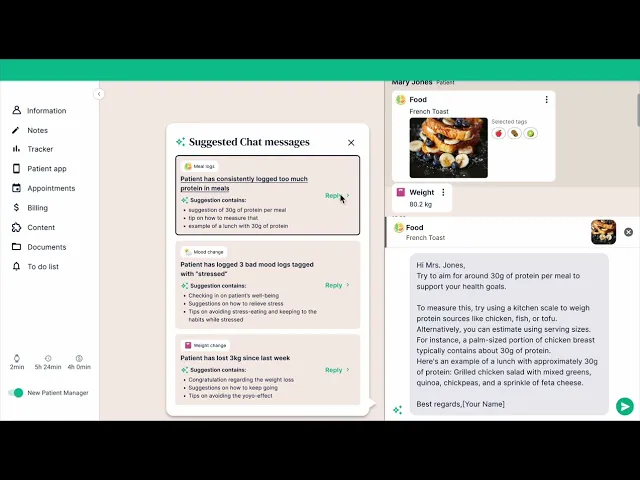
Coaches already had AI to help draft replies in their chat window with patients, but they still had to figure out what deserved a response. My role was to design a new AI experience that reduced that cognitive load by surfacing the most valuable coaching opportunities as soon as a patient profile was opened.
Overview
One of Oviva's biggest product goals was improving coach efficiency without compromising the quality of care.
Coaches already had AI to help draft replies in their chat window with patients, but they still had to figure out what deserved a response. My role was to design a new AI experience that reduced that cognitive load by surfacing the most valuable coaching opportunities as soon as a patient profile was opened.
The Problem
A patient's chat acts as a complete timeline of their treatment. It includes messages, meal logs, habit updates, goals and other activities.
Before writing a response, coaches had to scroll through this history, piece together what had changed, decide what to prioritize in responding too, and only then use AI to help write the message.
This became an even bigger challenge as Oviva expanded pooled health coaching programmes, where a coach might be supporting a patient for the first time with little prior context. More time would be lost trying to understand the history of the patient in the chat.
The Problem
A patient's chat acts as a complete timeline of their treatment. It includes messages, meal logs, habit updates, goals and other activities.
Before writing a response, coaches had to scroll through this history, piece together what had changed, decide what to prioritize in responding too, and only then use AI to help write the message.
This became an even bigger challenge as Oviva expanded pooled health coaching programmes, where a coach might be supporting a patient for the first time with little prior context. More time would be lost trying to understand the history of the patient in the chat.
The Goal
Design an AI-assisted experience that helps coaches quickly identify the most valuable coaching opportunities without having to manually review a patient's entire history.
The solution needed to:
Surface five personalised coaching suggestions, prioritised by value.
Provide enough context for coaches to quickly understand why each suggestion was recommended.
Reduce the time and mental effort spent deciding what to respond to.
Keep coaches in control by allowing them to review and edit every AI-generated reply before sending it.
Support consistent, high-quality coaching, especially in pooled coaching programmes where coaches may have little patient context.
The Goal
Design an AI-assisted experience that helps coaches quickly identify the most valuable coaching opportunities without having to manually review a patient's entire history.
The solution needed to:
Surface five personalised coaching suggestions, prioritised by value.
Provide enough context for coaches to quickly understand why each suggestion was recommended.
Reduce the time and mental effort spent deciding what to respond to.
Keep coaches in control by allowing them to review and edit every AI-generated reply before sending it.
Support consistent, high-quality coaching, especially in pooled coaching programmes where coaches may have little patient context.
My role
Facilitated product discovery with engineering leadership
Led ideation and translated ideas into product concepts
Designed the end-to-end experience
Worked closely with engineering to refine the solution
Iterated based on feedback from coaches after launch
My role
Facilitated product discovery with engineering leadership
Led ideation and translated ideas into product concepts
Designed the end-to-end experience
Worked closely with engineering to refine the solution
Iterated based on feedback from coaches after launch
Discovery
To kick off the project, I facilitated a workshop with our CTO and three frontend engineers.
Rather than jumping straight into solutions, we aligned on the problem, mapped the current coaching workflow and explored where AI could remove friction without taking decision-making away from coaches.
One idea quickly stood out, and that's the direction we took forward.
Discovery
To kick off the project, I facilitated a workshop with our CTO and three frontend engineers.
Rather than jumping straight into solutions, we aligned on the problem, mapped the current coaching workflow and explored where AI could remove friction without taking decision-making away from coaches.
One idea quickly stood out, and that's the direction we took forward.

The current workflow of health coaches
The current workflow of health coaches
Are there any unanswered questions?
If yes, respond.
Safety checks
Any medical issues flagged that need attention? (Blood glucose/ blood pressure logs, medical conditions mentioned?)
Were there any new logs entered by the patient?
Reply to a few entries with feedback (e.g. meal, weight, and activity logs)
Give a bit of a summary, mention any visible trends, reaffirm positive choices
Give an outlook on what's next - any barriers, goals to achieve?
If the patient didn't log anything new
Send a reengagement message, to try to get them to log entries in their app
If no response after repeated reengagement attempts, warn that to stay on the program logs are required
Designing the experience
From there I explored a few ways to surface this new feature that could fit naturally into the existing workflow without overwhelming the interface.
The final experience allowed coaches to:
Open AI suggestions directly from the chat in the patient's profile.
See five prioritised coaching opportunities.
Understand why each suggestion was recommended.
See what it related to, such as a meal log, habit change or patient question.
Jump directly to the relevant point in the timeline to view the source.
Review, edit and send the suggested reply.
The goal wasn't to automate coaching—it was to reduce the time spent searching for context while keeping coaches fully in control of the final message.
Designing the experience
From there I explored a few ways to surface this new feature that could fit naturally into the existing workflow without overwhelming the interface.
The final experience allowed coaches to:
Open AI suggestions directly from the chat in the patient's profile.
See five prioritised coaching opportunities.
Understand why each suggestion was recommended.
See what it related to, such as a meal log, habit change or patient question.
Jump directly to the relevant point in the timeline to view the source.
Review, edit and send the suggested reply.
The goal wasn't to automate coaching—it was to reduce the time spent searching for context while keeping coaches fully in control of the final message.
Iteration & launch
Given the size of the feature and the pace of delivery, we didn't run formal usability testing before development. Instead, we aligned closely with engineering throughout the design process and relied on feedback from coaches after launch. Because coaches are internal users, we were able to quickly gather qualitative feedback, monitor adoption and understand whether the AI suggestions felt relevant and trustworthy.
We also tracked how coaches interacted with suggestions to learn how often they were used versus edited, helping the team improve both the ranking and the quality of future suggestions.
Iteration & launch
Given the size of the feature and the pace of delivery, we didn't run formal usability testing before development. Instead, we aligned closely with engineering throughout the design process and relied on feedback from coaches after launch. Because coaches are internal users, we were able to quickly gather qualitative feedback, monitor adoption and understand whether the AI suggestions felt relevant and trustworthy.
We also tracked how coaches interacted with suggestions to learn how often they were used versus edited, helping the team improve both the ranking and the quality of future suggestions.
Reflection
This project reminded me that good AI experiences aren't different to any other good user experience. The goal is to discover how AI can help remove friction, and achieve the desired goal even faster while keeping the quality output the same (or better).
By helping coaches quickly understand what deserves their attention, rather than simply helping them write faster, we designed an experience that supported better decisions while preserving the human expertise that's central to quality coaching.
Reflection
This project reminded me that good AI experiences aren't different to any other good user experience. The goal is to discover how AI can help remove friction, and achieve the desired goal even faster while keeping the quality output the same (or better).
By helping coaches quickly understand what deserves their attention, rather than simply helping them write faster, we designed an experience that supported better decisions while preserving the human expertise that's central to quality coaching.
Next projects
View next project


Next projects
View next project
Next projects