Multimodal & AI UX
Multimodal infotainment system for level 4 autonomous cars


Project Duration
9 months +
Team
Designer & Front-end devs
Outcomes:
Increased level of trust in self-driving cars
Multimodal & AI UX
Multimodal infotainment system for level 4 autonomous cars
Designing an infotainment system + AI agent experience for level 4 autonomous cars
Multimodal & AI UX
Multimodal infotainment system for level 4 autonomous cars
Project Duration
9 months +
Team
Designer & Front-end devs
Outcomes:
Increased level of trust in self-driving cars
Project duration
6 months Master's Thesis Project
Team
Alberto Pinardi, Anna Nguyen & I
Outcomes:
Increased level of trust in self-driving cars
The Problem - Lack of Trust
When older generations lose the ability to drive, they lose their independence, highlighting that mobility is not yet democratized. While autonomous vehicles offer a powerful solution by turning drivers into passengers, senior adoption remains a challenge due to ongoing trust and safety concerns.
The Problem - Lack of Trust
When older generations lose the ability to drive, they lose their independence, highlighting that mobility is not yet democratized. While autonomous vehicles offer a powerful solution by turning drivers into passengers, senior adoption remains a challenge due to ongoing trust and safety concerns.
The Solution
Our solution is an AI companion that transforms autonomous travel into a safe, intuitive, and empowering experience. Through multimodal interactions, it provides reassurance, guidance, and personalized support, enabling passengers to travel independently, stay entertained, and embrace greater freedom in their everyday lives.
The Solution
Our solution is an AI companion that transforms autonomous travel into a safe, intuitive, and empowering experience. Through multimodal interactions, it provides reassurance, guidance, and personalized support, enabling passengers to travel independently, stay entertained, and embrace greater freedom in their everyday lives.
The Process
We followed the five typical design thinking stages of empathizing, defining, ideating, prototyping, and testing as our design process. And while we kept moving on in the process, there was a constant need for more research and iterations as we gained more knowledge and understanding of what elements need to be considered when designing a solution for lack of trust in automation.
The Process
We followed the five typical design thinking stages of empathizing, defining, ideating, prototyping, and testing as our design process. And while we kept moving on in the process, there was a constant need for more research and iterations as we gained more knowledge and understanding of what elements need to be considered when designing a solution for lack of trust in automation.


Qualitative & Quantitative Research
We dived right into qualitative and quantitative research with the goal of evaluating user's perceptions of fear and distrust in autonomous mobility. We surveyed over 130 people and conducted expert as well as user interviews to support our quantitative insights.
Qualitative & Quantitative Research
We dived right into qualitative and quantitative research with the goal of evaluating user's perceptions of fear and distrust in autonomous mobility. We surveyed over 130 people and conducted expert as well as user interviews to support our quantitative insights.
62% of our survey takers perceive self-driving cars as a benefit for people with driving impairments and restrictions
Our Users Emotions
Although people feel anticipation for using self-driving cars, we found that there is an ongoing fear and perception of loss of control or helplessness when thinking of autonomous vehicles. This suggests that the general population is not quite ready for autonomous cars at least currently.
Our Users Emotions
Although people feel anticipation for using self-driving cars, we found that there is an ongoing fear and perception of loss of control or helplessness when thinking of autonomous vehicles. This suggests that the general population is not quite ready for autonomous cars at least currently.

Users think that the collaboration between traditional car companies and tech companies would result in the ultimate self-driving car.
Information For Trust
Our interviewees stated that in order for autonomous vehicles to gain their trust, the technology will have to vindicate its safety and reliability within those next 10 years. Some of our interviewees said they wouldn't trust an autonomous car nowadays, but after watching a short video on self-driving cars, all of our users stated that they would be willing to test-drive a self-driving car today. This showed us that people will trust autonomy more and even today, when they are informed about its capabilities and limitations.
Information For Trust
Our interviewees stated that in order for autonomous vehicles to gain their trust, the technology will have to vindicate its safety and reliability within those next 10 years. Some of our interviewees said they wouldn't trust an autonomous car nowadays, but after watching a short video on self-driving cars, all of our users stated that they would be willing to test-drive a self-driving car today. This showed us that people will trust autonomy more and even today, when they are informed about its capabilities and limitations.

Synthesizing
So after we organized our insights with affinity maps and empathy maps it was time to finally define our How Might We questions, and really understand the exact problem we are trying to solve.
Synthesizing
So after we organized our insights with affinity maps and empathy maps it was time to finally define our How Might We questions, and really understand the exact problem we are trying to solve.
How might we communicate safety of autonomous cars to potential users?
How might we provide a personal experience in an autonomous car?
Who Do We Target?
We decided to focus on the tech-savvy Generation X and Baby Boomers, aged 41-75 years as our target segment because we saw a greater lack in trust and adoption rate amongst that segment. According to our research, millennials are much more open to adopting autonomous cars, therefore we decided to exclude them from our target segment.
Who Do We Target?
We decided to focus on the tech-savvy Generation X and Baby Boomers, aged 41-75 years as our target segment because we saw a greater lack in trust and adoption rate amongst that segment. According to our research, millennials are much more open to adopting autonomous cars, therefore we decided to exclude them from our target segment.
Creating Personas
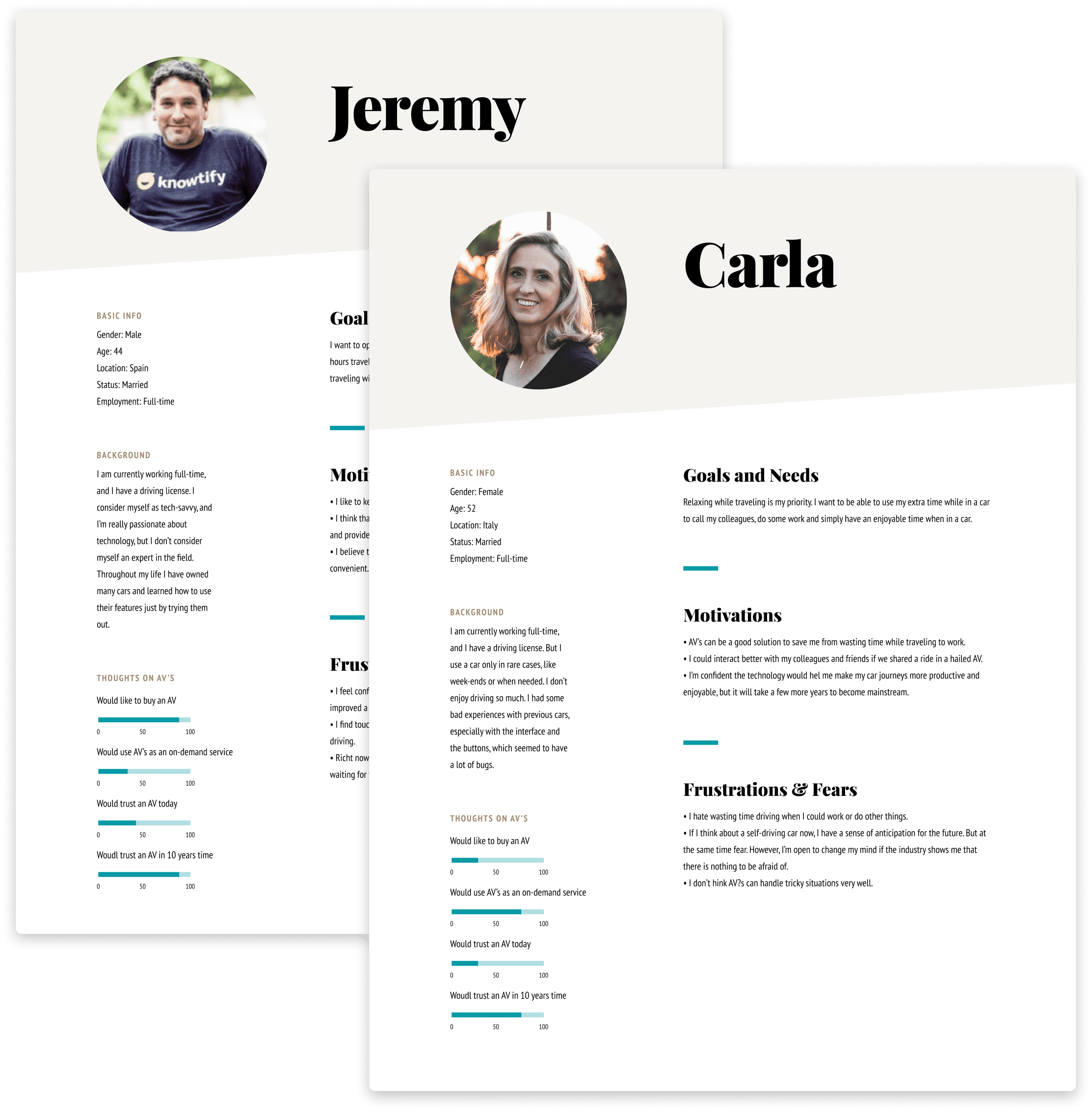
We carefully chose our personas' characteristics to match the concerns, needs, and frustrations our participants expressed in the interviews and survey.
Creating Personas
We carefully chose our personas' characteristics to match the concerns, needs, and frustrations our participants expressed in the interviews and survey.

Defining our Features
We went through a brainwriting session to ideate on features that we would need to have in order to strengthen our users' trust and perception of safety when interacting with an AI agent and multimodal infotainment system and then went ahead and created our first version of our Minimum Viable Product, Minimum Lovable Product, and Value Impact Matrix.
Defining our Features
We went through a brainwriting session to ideate on features that we would need to have in order to strengthen our users' trust and perception of safety when interacting with an AI agent and multimodal infotainment system and then went ahead and created our first version of our Minimum Viable Product, Minimum Lovable Product, and Value Impact Matrix.


Narrowing the Scope for Proof of Concept
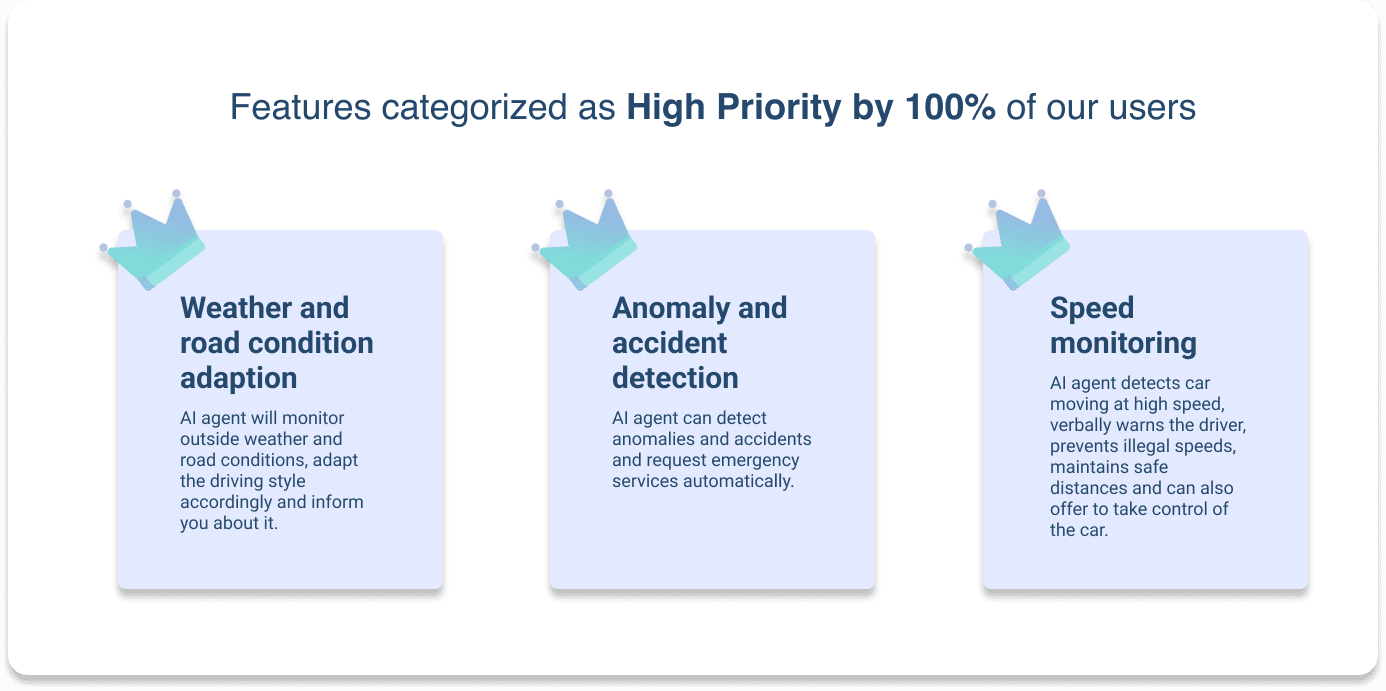
The next step was developing and testing a low-fi prototype, but in order to do so we needed to narrow down the scope of our features to focus on the main ones only. To ensure that our decisions are based on our users essential needs when prioritizing our features, we conducted card sorting sessions with users from our target segment (tech-savvy Generation X and Baby Boomers, aged 41-75 years).
Our objective was to task the users with the categorization of the AI agent’s features according to priority in order to better understand their perception and to guide us in the definition of features for our new iteration of our Minimum Viable Product.
Narrowing the Scope for Proof of Concept
The next step was developing and testing a low-fi prototype, but in order to do so we needed to narrow down the scope of our features to focus on the main ones only. To ensure that our decisions are based on our users essential needs when prioritizing our features, we conducted card sorting sessions with users from our target segment (tech-savvy Generation X and Baby Boomers, aged 41-75 years).
Our objective was to task the users with the categorization of the AI agent’s features according to priority in order to better understand their perception and to guide us in the definition of features for our new iteration of our Minimum Viable Product.

What our Users Don't Care About
After analyzing our card sorting outcomes, we realized that all the entertainment features were considered very low priority by our users. Therefore, we dropped our second HMW question for the scope of our low-fidelity prototype.
What our Users Don't Care About
After analyzing our card sorting outcomes, we realized that all the entertainment features were considered very low priority by our users. Therefore, we dropped our second HMW question for the scope of our low-fidelity prototype.
What is Feasable?
After we understood what features our users consider important, we needed to consider what features were important to our customers (tier 1 suppliers and OEM's in our case we were working with companies like Aptiv & Gestoos), and make sure to choose the features that are feasible for us to test in low-fidelity. Only after taking the user, customer, and feasibility into account, did we decide on our final versions of Minimum Viable Product, Minimum Lovable Product, and our List of Features for low-fidelity prototyping and testing.
What is Feasable?
After we understood what features our users consider important, we needed to consider what features were important to our customers (tier 1 suppliers and OEM's in our case we were working with companies like Aptiv & Gestoos), and make sure to choose the features that are feasible for us to test in low-fidelity. Only after taking the user, customer, and feasibility into account, did we decide on our final versions of Minimum Viable Product, Minimum Lovable Product, and our List of Features for low-fidelity prototyping and testing.
How might we communicate safety of autonomous cars to potential users?
How might we provide a personal experience in an autonomous car?


Prototyping & Testing
We prepared a customer jouney and a low fidelity prototype to test specific scenarios with our users as a proof of concept.
Prototyping & Testing
We prepared a customer jouney and a low fidelity prototype to test specific scenarios with our users as a proof of concept.


User Testing
In order to simulate the experience of our product to be as realistic as possible, we chose the Wizard of Oz method for our user testing. The objective of our Wizard of Oz test was to better understand how people perceive trust and safety while being driven by a fully autonomous car that interacts with passengers via an AI assistant using voice and gestures, and to improve their perceptions through our experience design:
- Voice interactions and visual feedback via the infotainment system and projected windscreen graphics;
- Simulation of a realistic user journey in a Level 4 autonomous vehicle.
For this test we conducted:
1. Pre-test interviews
2. Rating of level of trust and perceived safety after each task
3. Post-test interviews
User Testing
In order to simulate the experience of our product to be as realistic as possible, we chose the Wizard of Oz method for our user testing. The objective of our Wizard of Oz test was to better understand how people perceive trust and safety while being driven by a fully autonomous car that interacts with passengers via an AI assistant using voice and gestures, and to improve their perceptions through our experience design:
- Voice interactions and visual feedback via the infotainment system and projected windscreen graphics;
- Simulation of a realistic user journey in a Level 4 autonomous vehicle.
For this test we conducted:
1. Pre-test interviews
2. Rating of level of trust and perceived safety after each task
3. Post-test interviews
Outcome
After testing our solution concept with our users, their level of trust in autonomous cars greatly increased. Our users rated their level of trust after each task between 1 and 5, with 1 being the lowest and 5 being the highest.
The average level of trust before the test was 2.4 out of 5, and after the test 3.9.
Outcome
After testing our solution concept with our users, their level of trust in autonomous cars greatly increased. Our users rated their level of trust after each task between 1 and 5, with 1 being the lowest and 5 being the highest.
The average level of trust before the test was 2.4 out of 5, and after the test 3.9.
Important Design Decisions
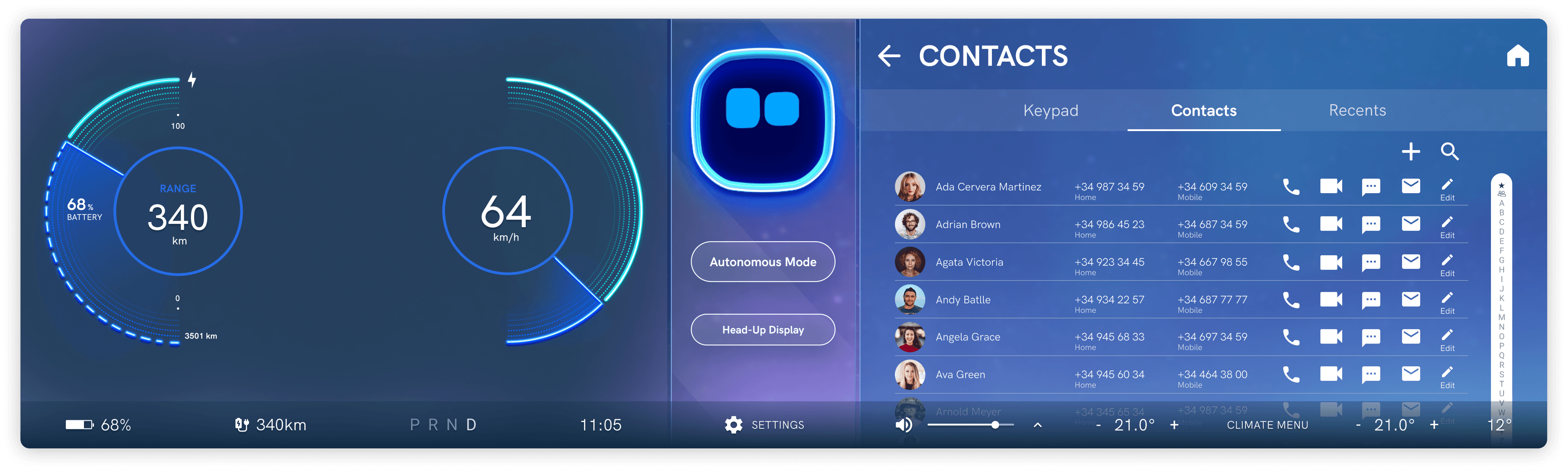
The shift from driving mode to autonomous mode must be communicated very clearly, therefore we have made the cluster gauge change in color, as well as show the autonomous sign in the center. The autonomous mode button is larger than the head-up display as it is crucial to be easily accessible and visible.
- The AI voice assistant’s avatar turns green whenever it is actively listening and speaking so that the user has a visual feedback of when the AI agent is active.
- The computer vision is an essential feature to help our users gain trust in autonomous cars by giving them real-time feedback of what the car is seeing and doing
Important Design Decisions
The shift from driving mode to autonomous mode must be communicated very clearly, therefore we have made the cluster gauge change in color, as well as show the autonomous sign in the center. The autonomous mode button is larger than the head-up display as it is crucial to be easily accessible and visible.
- The AI voice assistant’s avatar turns green whenever it is actively listening and speaking so that the user has a visual feedback of when the AI agent is active.
- The computer vision is an essential feature to help our users gain trust in autonomous cars by giving them real-time feedback of what the car is seeing and doing




Next projects
View next project


Next projects